
Heavy Truck Rubber Parts for SINOTRUK, Volvo, MAN, Mercedes-Benz, and DAF
09/01/2026
Genuine vs OEM vs Aftermarket Chinese Truck Parts: What Importers Must Know
10/12/2026
How to Verify a Chinese Truck Parts Supplier Before You Pay
Direct answer: To verify a Chinese truck parts supplier, run five hard checks before any deposit: (1) match the company name on the business license to the name on the bank account, (2) confirm the Unified Social Credit Code in China’s national credit system, (3) obtain photo or video proof of the exact part number you need, (4) test one sample order before a bulk order, and (5) keep at least 30% of the contract value as a balance payable against inspection. Suppliers that cannot pass all five are a payment risk, regardless of how good the price looks.
Most sourcing losses on Chinese truck parts do not come from bad products. They come from paying a company whose legal identity, stock position and shipping capability were never checked. The five checks below take about two weeks and cost almost nothing. Skipping them can cost a full container.
Why heavy truck parts sourcing carries more risk than consumer goods
Heavy truck parts are a high-value, low-volume category. A single Weichai or Sinotruk engine assembly can be worth thousands of US dollars, and a mixed container of engine, gearbox and axle parts has a high declared value at customs. China is the dominant source: the OEC’s bilateral trade profile shows China exporting other motor vehicle components to the United States, Kazakhstan, Japan, Mexico and Thailand, with the top single destination exceeding US$145 million in a single month (OEC, June 2026).
That volume attracts both legitimate wholesalers and intermediaries with no stock. The verification job is to separate them.
Side note for buyers: the parts themselves sit under HS heading 8708 — « parts and accessories of the motor vehicles of headings 8701 to 8705 », which covers bumpers (8708.10) and clutch parts (8708.93.2) among others (findhs.codes). Knowing your HS code before you negotiate makes duty and freight quotes comparable between suppliers.
Step 1 — Match the legal name to the bank account name
Ask for a scanned business license. Then compare three strings character by character:
- Company name on the license
- Company name on the proforma invoice
- Account holder name on the bank transfer instruction
If the payment instruction names an individual, a Hong Kong shell, or a third company, stop. Payment diversion to an unrelated account is the single most common mechanism in Chinese supplier fraud, and it is also what makes recovery nearly impossible. Business-license and record verification is the first-line control recommended by China-focused due-diligence providers (Cathay Partners).
Step 2 — Validate the Unified Social Credit Code
Every legally registered Chinese company has an 18-character Unified Social Credit Code. You can validate it against the national credit information system and cross-check:
| Check | What it proves | Red flag |
|---|---|---|
| Registration status | Company is active, not revoked or « abnormal » | Status shows the company as cancelled or revoked |
| Registered capital | Rough scale of the entity | Capital far below your order value |
| Establishment year | Trading history | Registered a few months ago |
| Business scope | Whether parts trading/export is a permitted activity | Scope limited to unrelated industries |
| Legal representative | Who is accountable | Frequent changes in a short period |
A factory audit or a documented verification of the license, ownership and litigation history is the standard method legal-advisory firms use for overseas buyers (China Legal Experts).
Step 3 — Separate the wholesaler from the middleman
There is nothing wrong with trading companies — many, including long-established wholesalers, hold stock and ship faster than factories. The problem is a supplier who claims to be a manufacturer and cannot prove it.
Ask for:
– A warehouse photo or short video showing your part number on the shelf, with a handwritten date
– Branded packaging photos (carton, label, anti-counterfeit marking)
– A video call walking through the stock area while you are on the line
A supplier who has real stock will send this within a day. A supplier who is only brokering will send a catalogue PDF and vague answers. For wholesalers, the warehouse is the proof; for factories, the production line is the proof. Verification checklists built for Chinese sourcing consistently put the factory/warehouse audit ahead of every document-based check (Supplyia).
Step 4 — Verify the part number, not the product photo
Generic product photos are recycled across dozens of websites. What you must verify is the identifier.
For Chinese heavy trucks, verify in this order:
- OEM part number — the manufacturer’s number, e.g. the fuel injector VG1560080276 for Weichai WD615 / WP10 engines
- Engine or vehicle model — WD615, WP10, WP12, or the truck model it fits
- Photo of the actual unit — send your old part photographed from several angles so the supplier matches it physically
The same injector number is sold across HOWO, Shacman Delong, Foton Auman and bus applications, so a single « fits HOWO » label is not enough (YEM Parts listing reference). Ask your supplier to state the OEM number in writing on the invoice. This is how we verify a part number against the truck model before quoting.
Step 5 — Test with a sample order first
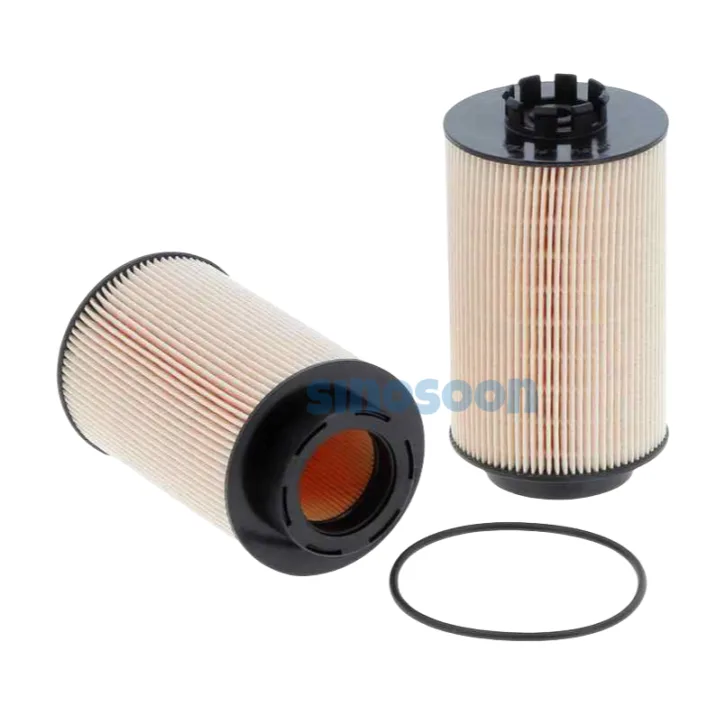
A sample order is cheap insurance. Pick 3–5 fast-moving items from your planned container — filters, brake chambers, clutch plates, injectors — and buy them as a small air-freight order.
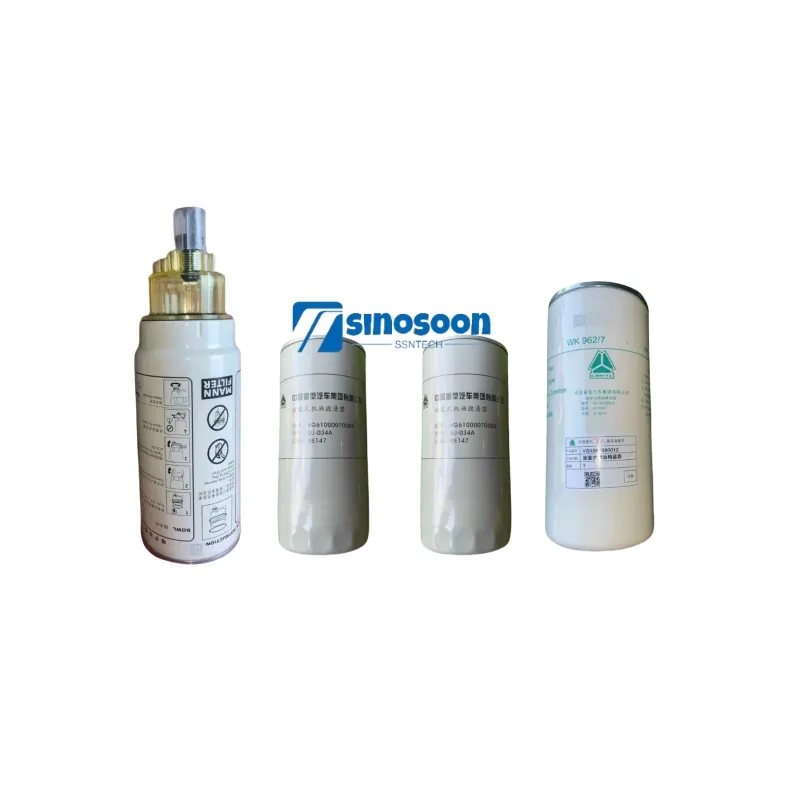
Typical sample-order items from our own warehouse: HOWO A7 air filter WG9525195201, HOWO oil filter VG61000070005, HOWO 420 clutch pressure plate AZ9921161500, fuel injector VG1560080276.
Evaluate:
– Does the packaging survive shipping?
– Do dimensions and thread pitches match the drawing?
– Is the material finish equivalent to your old part?
– Is the documentation (packing list, invoice) clean enough for your customs broker?
If the sample order is smooth, scale. If it is not, you have paid a few hundred dollars to avoid a five-figure mistake.
Step 6 — Fix payment terms before production, not after
| Term | Risk to buyer | When to accept |
|---|---|---|
| 100% T/T in advance | Highest | Only with an established, audited supplier |
| 30% deposit + 70% before shipment | High | Very common in Chinese truck parts trade; require pre-shipment photos |
| 30% deposit + balance against B/L copy | Medium | Reasonable default for repeat orders |
| Letter of Credit (L/C at sight) | Low | Best for first large orders over US$30,000 |
| Escrow-style trade assurance | Low | Good for small and mid-size first orders |
Note that escrow and trade-assurance protections apply only to orders paid and shipped through the platform that offers them, and return-shipping costs usually stay with the buyer — confirm the return policy before you order (Alibaba sourcing guidance).
Step 7 — Check export capability, not just domestic sales
A supplier can be legitimate and still be unable to export. Confirm: do they have their own export licence or a stable customs broker, can they issue the documents your country needs (invoice, packing list, certificate of origin, and fumigation or non-wood packing declaration where required), and can they quote a CIF or FOB port you actually use? Chinese export-licence and customs-document verification is a distinct check from business-licence verification (IF Lawyer export-licence guide).
Red flags that end the conversation
| Warning sign | Why it matters |
|---|---|
| Price 40%+ below every other quote | Either counterfeit, used-as-new, or bait pricing |
| Payment only to a personal account | No legal recourse |
| Refuses a video call or a dated warehouse photo | No stock |
| Cannot state the OEM part number in writing | No technical control |
| Business licence name ≠ invoice name | Identity mismatch |
| Pushes you past the sample order stage | Volume fraud pattern |
| « OEM » claimed but no licence relationship described | Replica risk |
FAQ: Verifying a Chinese truck parts supplier
How long does supplier verification take?
Plan for 10–15 working days: 2–3 days for document checks, 3–5 days for a warehouse and reference check, and 5–7 days for a sample order by air.
Can I verify a Chinese company for free?
Yes. The business-licence number, registration status, establishment date and registered capital can be checked through China’s public credit systems. Paid services add factory audits, staff interviews and litigation history.
Is a Chinese trading company or a factory better for truck parts?
For mixed orders across engine, gearbox, chassis and cabin systems, a stock-holding wholesaler is usually faster and cheaper than ordering from several factories. What matters is that the wholesaler actually holds the stock and states the OEM numbers on the invoice.
How do I know if a part is genuine?
Compare the OEM number stamped on the part with the invoice, check the packaging and anti-counterfeit marks, and measure it against your old part. Independent guidance on genuine versus OEM versus aftermarket parts is clear that OEM parts are made to the vehicle maker’s specification while aftermarket parts are not (European Collision).
What payment term should a first order use?
For a first order above US$30,000, an L/C at sight gives the strongest protection. For smaller first orders, a 30/70 split with pre-shipment photo approval is the practical middle ground.
What documents should arrive with the shipment?
Commercial invoice, packing list, bill of lading, certificate of origin, and product-specific documents where your customs authority requires them. Ask for the HS code on the invoice to match your own classification under heading 8708.
What if the supplier only replies with a catalogue?
Treat it as no proof of stock. Ask one direct question: « Please send a dated photo of part number XX on your warehouse shelf. » A supplier with inventory answers the same day.
Get a verified quote instead of a risky one
Sinosoon Technology Co., Ltd. has supplied Chinese heavy-duty truck and bus parts from Jinan, Shandong since 2010 — the same city as Sinotruk’s manufacturing base — covering engine, transmission, axle and chassis, cabin, body, brake, filter and electrical systems for HOWO, Shacman, FAW, Foton, Dongfeng, Weichai and Cummins applications.
Send the truck model, the OEM part number and photos, and you will get a written quotation that states the part number, the brand of the part and the shipping option — not a catalogue.
- Browse engine parts, transmission parts, brake parts or all truck spare parts
- Compare the HOWO and Shacman ranges
- Request a quotation: market@sinosoon.com · WhatsApp +86 15562608606
Sources cited: OEC bilateral trade data (June 2026), findhs.codes HS 8708 structure, Cathay Partners China supplier due diligence, China Legal Experts company verification guide, Supplyia supplier verification methods, Alibaba sourcing guidance, IF Lawyer export-licence guide, European Collision OEM vs aftermarket analysis.
How to compare two suppliers on the same five checks
| Check | What a real wholesaler shows | What a middleman shows |
|---|---|---|
| Legal name | Business licence name equals bank account name | Account under a different or personal name |
| Credit code | Unified Social Credit Code resolves on gsxt.gov.cn | Code given only in a chat message, never in a document |
| Business scope | Scope includes manufacture or wholesale of the part family | Scope is trading, consulting or unrelated goods |
| Part number traceability | Returns the OEM reference and the factory it comes from | Sends a photo and asks you to confirm it looks right |
| Physical capability | Invites an inspection or a video walk-through of the warehouse | Avoids any visit and offers only stock photos |
A supplier that cannot pass the third row will usually fail the other four.
FAQ
How do I verify a Chinese truck parts supplier is legitimate?
Run four checks before any deposit: the business licence name must match the bank account name, the Unified Social Credit Code must resolve on China’s national credit system, the registered business scope must cover the part family, and a paid sample order must arrive before a bulk order is placed.
What is a Unified Social Credit Code and where do I check it?
It is the 18-character identifier on every Chinese business licence. Look it up on gsxt.gov.cn, the national enterprise credit system, and compare the registered name, legal representative, business scope and status against the documents the supplier sent you. A code that does not resolve is a stop signal.
How can I tell a wholesaler from a middleman?
Ask for the factory name behind a specific part number, then ask for the OEM reference that factory works from. A wholesaler answers with a document. A middleman answers with a photo and a price. A video walk-through of the warehouse, or an unannounced visit, settles it faster than any certificate.
Is a business licence enough to prove a factory exists?
No. A licence proves a company is registered, not that it owns production. Ask for the factory’s own business licence if the supplier claims to manufacture, and check whether the addresses match. Many trading companies hold a licence for an office while sourcing from several workshops.
Should I place a sample order before a bulk order?
Yes, and pay for it. A free sample proves nothing about production capability and often comes from a different batch. A paid sample gives you a traceable order, an invoice and a shipping record, which is what you would need if the relationship later goes wrong.
How do I avoid scams when buying truck parts wholesale from China?
Keep the three documents aligned: licence, bank account and invoice. Refuse any request to pay a personal account. Treat a mid-order change of bank details as a fraud attempt until a stamped bank certificate arrives. And never send a deposit before the credit code has been checked on gsxt.gov.cn.
Can I verify a supplier without visiting China?
Partly. Documents, the credit system and a third-party pre-shipment inspection cover most of the risk. What remote checks cannot confirm is whether the production line exists, so for a first container either use a third-party factory audit or ask for a live video walk-through with the warehouse sign and part numbers visible.

