
Chinese Truck Parts Videos | HOWO, SITRAK, Shacman and FAW
10/13/2026
Designing a 25 t Electric Dump Truck: How the 380 kWh Pack and the 38.6% Gradeability Were Derived
10/14/2026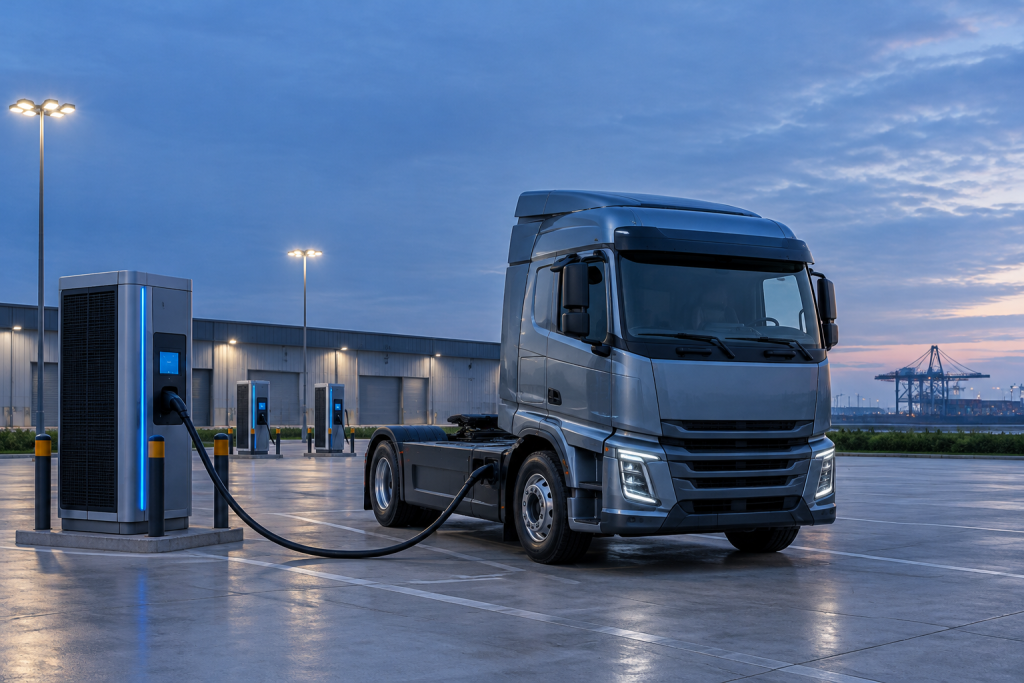
The short answer: electrification of heavy trucks has stopped being a pilot programme. In China it is now a mainstream purchase decision — new-energy heavy trucks took roughly 29% of 2025 sales and about 54% of December sales. In Europe it is still a small but fast-growing slice (2.3–4.8% of the market in H1 2026, depending on how you count). Battery pack prices hit a record low of USD 108/kWh globally (USD 84/kWh in China) in 2025, and independent TCO work now shows battery-electric trucks cheaper to run than diesel in most major European markets. The technical question is no longer if but which route — and the answer depends on duty cycle, not on brand preference.
1. What actually changed in 2025–2026
China: from pilot to default
- 231,100 new-energy heavy trucks were sold in China in 2025, up 182% year-on-year, with full-year penetration around 29% on the NEV measure (which includes plug-in hybrids). Battery-electric-only penetration was 20.5%, up 11.3 percentage points from 2024. CnEVPost · ChinaEVHome
- December 2025 was the tipping point: 45,300 electrified heavy trucks were registered — about 54% of the month’s heavy-truck sales, the first month electric outsold diesel in China. Some of that was demand pulled forward from 2026, so the monthly record should not be read as a permanent level. electrive
- Policy has moved from subsidy to targets plus rules: Beijing now aims for 40% new-energy penetration in heavy trucks by 2030, and Stage 4 heavy-duty fuel-consumption standards (in force since July 2025) require a 12–16% improvement over Stage 3. The renewed scrappage scheme pays up to about USD 20,000 to replace pre-China IV trucks — enough to cover roughly 20–50% of the electric price premium. CnEVPost · IEA Global EV Outlook 2026
- Competition is already reshuffling the OEM order: XCMG led 2025 electric heavy-truck sales with 15.4% share, ahead of SANY and FAW Jiefang — brands that were not in the traditional diesel top three.
Europe: small share, fast growth, tightening CO₂ rules
- In H1 2026, 146,000 heavy trucks were sold in the EU; about 3,400 were zero-emission — a 2.3% share, up from 1.4% a year earlier. ICCT
- ACEA’s registration data for the same period shows electrically chargeable trucks growing 47.7% to a 4.8% market share, led by Germany (+88.5%) and the Netherlands (+44.5%). ACEA
- For 2025 as a whole, European electric truck sales grew about 40% to nearly 17,000 units, roughly 3% of truck sales. IEA
United States: policy stepped back, economics did not
- On 12 February 2026 the EPA repealed the federal greenhouse-gas emission standards for commercial trucks — removing the regulatory pull that had shaped US fleet planning since 2023. California’s own truck rules were rolled back in late 2025 as well. overview of the rescission
- The practical consequence: in North America, electrification decisions are now driven almost entirely by cost per mile, duty cycle and depot electricity prices rather than compliance deadlines — which favours closed-loop fleets (drayage, distribution, regional haul) over long-haul first.
2. The demand side: what buyers are actually asking for in 2026
Three forces are pulling electric trucks into fleets — and all three are now measurable rather than aspirational:
- Total cost of ownership. Battery pack prices fell 8% in 2025 to a record USD 108/kWh globally, and to USD 84/kWh in China, driven by LFP chemistry and manufacturing overcapacity. BloombergNEF Transport & Environment’s September 2026 analysis finds battery-electric heavy trucks already have a lower TCO than diesel in six of nine major EU markets — markets that together represent 46% of new heavy-truck sales — with paybacks as short as two years and lifetime savings reaching into the tens of thousands of euros. T&E The IEA’s 2026 outlook puts battery-electric heavy freight trucks more than 10% below diesel on TCO, on par with LNG. IEA
- Shipper-side pressure. Large freight buyers increasingly contract for zero-emission transport to hit their own Scope 3 targets, so the requirement reaches hauliers through tenders rather than through their own sustainability reports.
- Driver-facing factors. Vibration, noise and shift quality are decisive where labour is scarce: OEMs are pairing electrification with multi-speed powershift transmissions and quieter cabs specifically to sell the truck to the driver as much as to the fleet accountant.
Against these pull factors stand three real frictions: upfront price (still higher than diesel even after incentives), utilisation risk (an electric truck that cannot charge fast enough earns less), and residual value uncertainty for early battery generations.
3. The five technical routes — and what each is actually for
Most confusion in fleet planning comes from treating « electric truck » as one product. In reality there are five commercial routes on the market in 2026, and they win in different duty cycles.
Route A — Battery-electric, charged at the depot or on DC fast chargers
What it is: a large LFP or LFP/NMC pack (typically 280–600+ kWh in heavy trucks), charged overnight at the depot or on 120–350 kW public DC chargers.
Where it wins: closed loops and predictable routes — mining and quarry haulage, port drayage, construction and mixer work, municipal and regional distribution, and any duty cycle that returns to base daily.
Limits: payload penalty from battery mass, and dependence on depot power capacity. This is why 800-volt architectures and lighter packs matter more in heavy trucks than in cars: every kilogram of battery is a kilogram of freight not carried.
Route B — Battery-electric with battery swapping
What it is: under-chassis battery swap for tractors, with packs exchanged in minutes rather than charged in place.
2026 evidence: CATL finished 2025 with 1,325 swap stations in China, of which 305 serve trucks, and is targeting 900 truck stations in 2026 on a « five horizontal, five vertical » highway backbone. Its Qiji network opened a 1,250 km swap corridor on the Chengdu–Wuhan section of the Shanghai–Chengdu expressway in December 2025. Rival Qiyuan Green Power already operates more than 1,600 charging and swapping stations across 208 cities. electrive · CarNewsChina · CarNewsChina
Where it wins: high-utilisation long-haul where the truck must keep moving — the swap decouples vehicle range from charging time. Limits: standardisation between brands, station capex, and battery ownership models that fleets must accept (battery-as-a-service rather than battery-on-the-balance-sheet).
Route C — Megawatt charging (MCS) for long-haul
What it is: the Megawatt Charging System standard, designed to deliver 1 MW and up to 3.75 MW so a truck can recharge during a mandatory rest break. MCS overview
2026 evidence: Scania is offering MCS on battery-electric trucks from mid-2026; North America’s first megawatt truck charge (a 1.2 MW liquid-cooled system) was demonstrated in March 2026; Germany’s transport ministry launched a USD 1.16 billion programme in May 2026 to build electric truck charging along corridors, explicitly including MCS. Scania · electrek
The real bottleneck is the grid, not the plug. China’s largest public hub (Beichuan, Sichuan) buffers 18 megawatt charging positions at 1.44 MW each plus 108 liquid-cooled 600 kW points with on-site battery storage, precisely because a corridor site cannot draw that load directly. Huawei Digital Power China already counts more than 9,000 public charging stations dedicated to heavy electric trucks. truck charging survey
Product proof points: Volvo’s 2026 FH/FM Electric range extends to 700 km, and XCMG’s Hanjing long-haul tractor pairs an 800-volt architecture with megawatt-class charging, completing a 24-hour, 49-tonne endurance run of 1,366 miles (about 2,198 km). Volvo Trucks · The EV Report
Route D — Hydrogen fuel cell (FCEV)
What it is: a fuel-cell powertrain refuelled in roughly the time of a diesel fill, with longer range and no payload-robbing battery mass.
2026 evidence: China’s MIIT targeted an end-user hydrogen price below 25 yuan/kg (about USD 3.5/kg) by 2030 — and around 15 yuan/kg in leading regions — alongside a goal of 100,000 fuel-cell vehicles in operation by 2030. A liquid-hydrogen fuel-cell system tested in Beijing was reported to give heavy trucks more than 1,000 km of range. electrive · Gasgoo
Where it wins: high-utilisation, high-payload corridors; very cold climates where battery range collapses; and sites where grid reinforcement is impossible but hydrogen can be trucked in. Limits: hydrogen cost per kilogram is still the binding constraint, plus refuelling infrastructure and fleet-scale fuel supply agreements.
Route E — Range-extender (EREV) and hybrid heavy trucks
What it is: an electric drivetrain with a small generator (diesel, gas or gas-engine) that recharges the battery — the pragmatic answer for routes where charging is not yet reliable.
2026 evidence: China has just tightened the rulebook: the revised range-extender standard QC/T1086-2026 takes effect on 1 November 2026 with quantified targets for power-control accuracy, EMC, NVH and durability, while the EREV market passed 1 million annual units. CarNewsChina
Where it wins: mixed-route fleets and markets without charging coverage; it is a transition hedge, not a long-term architecture — expect it to lose share as corridor charging and swapping fill in.
4. Choosing a route by duty cycle (not by brand)
| Duty cycle | Best route today | Why |
|---|---|---|
| Mine / quarry / port / construction (closed loop) | A — depot charging | Fixed routes, high daily kilometres, cheap depot power; no public infrastructure needed |
| Regional distribution (<300 km/day) | A — depot charging | Returns to base nightly; smallest battery for the job |
| High-utilisation long-haul on an equipped corridor | B — battery swap | Swap minutes instead of charging hours; proven on 1,250 km corridors in China |
| Long-haul with grid-strong stops, moderate utilisation | C — megawatt charging | Recharge inside the mandated rest break once MCS sites exist |
| Very cold climate / extreme payload / no grid | D — fuel cell | Refuel time and range behave like diesel; hydrogen price is the swing factor |
| Mixed routes, patchy charging | E — range extender | Keeps the fleet electric where it matters, without stranding the truck |
Enabling layers that apply to all five routes: LFP-dominant chemistry (the reason packs reached USD 84/kWh in China), 800-volt electrical architecture, silicon-carbide inverters, multi-speed powershift transmissions for efficiency and driveability, heat-pump based thermal management for both cabin and pack, and regenerative braking — which in heavy trucks is not a gimmick but the main mechanism that keeps brake service intervals long.
5. What this means for parts buyers and the aftermarket
Electrification does not remove the spare-parts business — it moves it. For anyone sourcing or stocking Chinese heavy-truck parts, the practical shifts are:
- Wear items move up the list. With regenerative braking doing much of the deceleration, friction brakes and drums last longer; tyres, suspension, kingpins, steering and wheel-end components carry more of the maintenance budget per kilometre.
- New categories appear: high-voltage connectors and cables, DC/DC converters, e-axle gearing and bearings, pack cooling components, contactors, insulation monitoring, thermal-management hose and pumps.
- Powertrain-specific parts shrink in the pure-BEV fleet — no injectors, turbos, EGR or engine internals — but range-extender and hybrid trucks keep them, which is exactly why the EREV route matters commercially for parts suppliers in this decade.
- Service capability becomes a product. High-voltage safety training, insulation testing tools, and battery state-of-health diagnostics are becoming part of what fleet customers expect from a supplier, not an add-on.
- Chassis and cab parts stay the same. Trucks still hit kerbs, still rust, still need filters, brake chambers, valves, lamps, mirrors, cab mounts and cooling components — and the installed base of diesel trucks will keep consuming those parts well past 2030.
That dual reality — a fast-electrifying new-truck market sitting on top of a very large legacy diesel fleet — is the reason we keep stocking both the conventional catalogue and the new high-voltage and thermal parts as volumes grow. Browse the parts catalogue or send us a parts list if you are specifying for either fleet type.
6. What to watch, 2027–2030
- China’s 40%-by-2030 target is the single most important number for global parts demand: if it holds, the second-hand and aftermarket mix changes much faster than most western suppliers assume.
- Charging, not trucks, sets the pace. MCS corridors in Europe, swap networks in China, and grid-buffered hubs with on-site storage are the gating items.
- Policy divergence. With US federal GHG truck standards repealed in February 2026, North American electrification will track diesel prices, state rules and depot economics — a slower, more uneven curve than Europe or China.
- Hydrogen price. Sub-25 yuan/kg in China by 2030 would make fuel-cell trucks genuinely competitive in heavy, cold or remote duty cycles; failure to hit it leaves them in a niche.
- Residual values and battery health. Second-life and repowering models will decide how quickly fleets actually replace, not just buy, electric trucks.
Frequently asked questions
Are electric heavy trucks already cheaper than diesel?
On total cost of ownership, in several markets yes. T&E’s September 2026 analysis found battery-electric heavy trucks cheaper to operate than diesel in six of nine major EU markets (46% of new heavy-truck sales), with paybacks as short as two years. The IEA puts battery-electric heavy freight trucks more than 10% below diesel on TCO. Purchase price is still higher — the difference is running cost, incentives and residual value.
How far can an electric truck go in 2026?
Production long-haul models announced in 2026 quote up to about 700 km of range (Volvo FH/FM Electric), and megawatt-charged 800-volt prototypes have completed multi-thousand-kilometre endurance runs at 49 tonnes in 24 hours. Real-world range still depends on load, terrain, temperature and speed.
Battery swap or megawatt charging — which will win?
They solve different problems. Swapping removes vehicle downtime and suits very high-utilisation corridors with standardised packs; megawatt charging keeps the pack on the truck and suits fleets with access to strong grid connections at stops. China is investing heavily in both — 305 truck swap stations for CATL alone at the end of 2025, and thousands of public truck charging stations nationwide.
Do electric trucks kill the spare-parts business?
No — it relocates it. Friction brake, engine and exhaust parts decline per vehicle in a pure-BEV fleet, while tyres, suspension, wheel-end, thermal-management and high-voltage components grow. Hybrid and range-extender trucks, still growing in China, keep much of the conventional engine parts demand alive through the 2020s.
What should a fleet specify first?
Start from the duty cycle: daily kilometres, return-to-base pattern, payload sensitivity, and available depot power. That determines the route — depot charging, swap, megawatt charging, fuel cell or range extender — long before brand selection matters.
Sources
- CnEVPost, « China targets 40% penetration for new-energy heavy trucks by 2030 », 13 June 2026 — cnevpost.com
- electrive, « Year-end surge: electric trucks outsell diesel for the first time in China », 23 January 2026 — electrive.com
- ChinaEVHome, « China Electric Heavy-Duty Truck Penetration Tops 20% in 2025 », 29 January 2026 — chinaevhome.com
- IEA, Global EV Outlook 2026 — Trends in other EV modes — iea.org
- ICCT, « European heavy-duty vehicle market development » (H1 2026), 30 July 2026 — theicct.org
- ACEA, new commercial vehicle registrations H1 2026, 29 July 2026 — acea.auto
- BloombergNEF, « Lithium-Ion Battery Pack Prices Fall to $108 Per Kilowatt-Hour », 9 December 2025 — bnef.com
- Transport & Environment, « Are electric trucks cheaper to operate than diesel? », 28 September 2026 — transportenvironment.org
- electrive, « CATL reports 1,000 battery swap stations », 5 January 2026 — electrive.com
- CarNewsChina, « CATL launched longest 1,250 km heavy-duty truck battery swap route », 23 December 2025 — carnewschina.com
- CarNewsChina, « CATL becomes China’s largest heavy-duty truck battery swapping operator », 25 August 2026 — carnewschina.com
- Megawatt Charging System — standard, power levels and national programmes — en.wikipedia.org
- Scania, « Megawatt charging — all you need to know about MCS » — scania.com
- electrek, « This charger’s first megawatt truck charge hits North America », 26 March 2026 — electrek.co
- Huawei Digital Power, Beichuan 100 MW truck charging station, 7 April 2026 — digitalpower.huawei.com
- Heavy truck charging station survey, 5 March 2026 — itkservices3.com
- Volvo Trucks press release, electric trucks with up to 700 km range, 14 April 2026 — volvotrucks.com
- The EV Report, « XCMG launches Hanjing long-haul electric heavy truck », 21 September 2026 — theevreport.com
- electrive, « China aims to cut hydrogen prices », 16 March 2026 — electrive.com
- Gasgoo, « China targets 100,000 fuel cell vehicles by 2030 », 17 March 2026 — autonews.gasgoo.com
- CarNewsChina, « China upgrades range extender rules as EREV market surpasses 1 million annual sales », 7 June 2026 — carnewschina.com
- EPA greenhouse-gas rescission for commercial trucks, 12 February 2026 — summary

