

ZF TraXon 12TX Transmission Spare Parts: Core Components for AMT Repair
08/29/2026
How to Verify a Chinese Truck Parts Supplier Before You Pay
10/12/2026ZF TraXon 12TX Transmission Spare Parts: Core Components for AMT Repair
08/29/2026How to Verify a Chinese Truck Parts Supplier Before You Pay
10/12/2026Heavy Truck Rubber Parts for SINOTRUK, Volvo, MAN, Mercedes-Benz and DAF
Rubber mounts are the least glamorous parts on a heavy truck and among the hardest to buy correctly. They look like a block of rubber between two steel plates, so in a photograph they all look much the same — but a mount that is dimensionally close and a mount that is actually right are not the same thing.
Get it wrong and the mount still bolts up. Then it misbehaves: the cab sits at the wrong height, the rubber is loaded in a direction it was not designed for, and it fails early. By then the truck has been back in the workshop twice, and the second time is at your cost.
This page covers what these parts do, how they are built, the reference numbers we supply for SINOTRUK, Volvo, MAN, Mercedes-Benz and DAF, and how to identify the correct one before you order.
What these parts do
Every mount on this page does the same job in principle: hold two assemblies together, let them move a controlled amount, and stop that movement turning into noise and fatigue.
Bolted steel-to-steel, a joint transmits everything. A cab or a cross-member fixed rigidly to the chassis passes road shock straight into the structure, and repeated shock is what cracks brackets and fatigues welds. A rubber mount interrupts that path. It carries the same load, but it does so through a material that deflects, damps and recovers, so the peak forces arriving at the structure are much lower.
The mount has to do three things at once, and the three are in tension with each other:
- Carry the static load — the weight of the cab, engine, transmission or bracket it supports, without collapsing or sagging permanently.
- Isolate vibration — stop engine and driveline frequencies reaching the cab, and stop road frequencies reaching the component.
- Limit movement — keep the two halves aligned under braking, cornering and rough ground, so hoses, linkages and harnesses are not stretched.
A mount that is too soft isolates well but lets the cab move further than the surrounding parts can tolerate. One that is too hard lasts well but transmits the vibration it was fitted to remove. That balance is why an equivalent-looking part from another application is not a safe substitute.
How a rubber mount is built
The parts on this page are rubber-to-metal bonded mounts. The rubber is not a separate cushion sitting between two plates — it is chemically bonded to them during vulcanisation, so the rubber and the steel become one component.
That bond is the whole design. The steel plates take the bolt loads and spread them; the rubber takes the load and does the damping; the bond is what transfers force between the two. When the bond separates, the mount does not simply get softer — it loses its stiffness and the assembly starts moving in a way nothing else is designed to allow.
Two families of shape appear in the photographs below, and they suit different jobs:
- Cylindrical and bellows types — a rubber column or a stack of rubber ribs between a top and bottom plate. These are loaded in compression and shear at the same time and are used where the mount has to allow a useful amount of movement while still isolating well. The ribbed (bellows) versions give a more progressive rate: soft for small movements, stiffer as the ribs close up.
- Box and plate types — a rubber block bonded inside or between steel plates, often with a defined bore or stud. These are used where the mount has to resist a load in a particular direction, or where the mounting space is flat rather than tall.
Both families appear across all five brands on this page, because all five solve the same problem — the shapes follow the space available on the vehicle, not the badge on the grille.
Where they are used
Depending on the vehicle design and installation position, rubber parts may be used for:
- Cab mounting and cab suspension
- Suspension support and vibration isolation
- Cross-member and bracket connection
- Engine, transmission or auxiliary-component support
- Shock absorption and noise reduction
- Protection of metal-to-metal contact points
These components are commonly made from durable rubber and metal-reinforced structures designed for heavy-duty vehicle operating conditions.
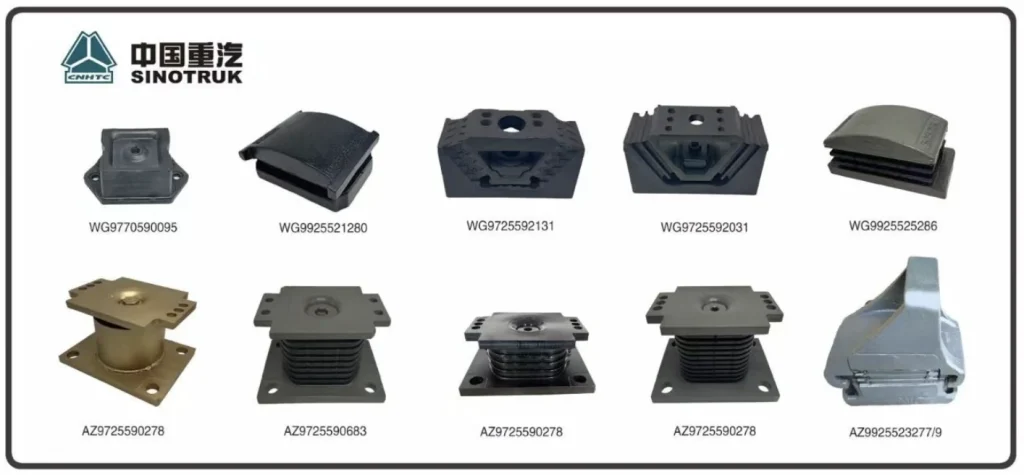
SINOTRUK Rubber Parts
We supply selected rubber parts for SINOTRUK truck applications. The references below are shown in the same order as the photograph.
| Reference number | Position in the photograph above |
|---|---|
| WG9770590095 | top row, first from left |
| WG9925521280 | top row, second |
| WG9725592131 | top row, third |
| WG9725592031 | top row, fourth |
| WG9925525286 | top row, fifth |
| AZ9725590278 | bottom row, first from left |
| AZ9725590683 | bottom row, second |
| AZ9925523277/9 | bottom row, fifth |
SINOTRUK numbers use the WG and AZ prefixes. The WG form is the workshop-order number; AZ numbers appear on the same families of parts. Where a number is written with a slash, as in AZ9925523277/9, the two forms refer to the same mounting position.
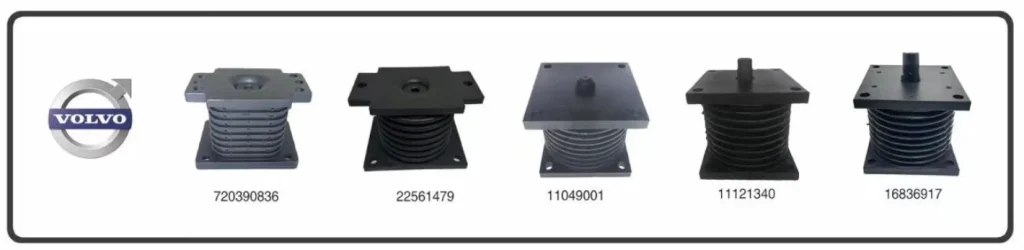
Volvo Truck Rubber Parts
For selected Volvo truck applications, commonly requested rubber components include:
| Reference number | Position in the photograph above |
|---|---|
| 720390836 | first from left |
| 22561479 | second |
| 11049001 | third |
| 11121340 | fourth |
| 16836917 | fifth |
When sourcing Volvo truck rubber mounts or buffers, check the original part number, the product dimensions and the mounting-hole arrangement — Volvo uses the same mount body in more than one height, and the height is what sets the cab attitude.
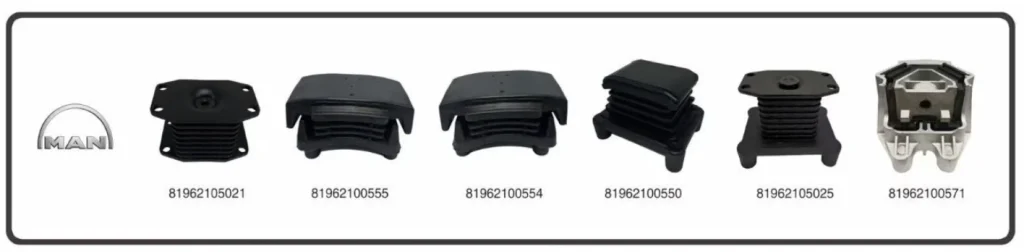
MAN Truck Rubber Parts
Our MAN truck rubber-parts range includes selected references such as:
| Reference number | Position in the photograph above |
|---|---|
| 81962105021 | first from left |
| 81962100555 | second |
| 81962100554 | third |
| 81962100550 | fourth |
| 81962105025 | fifth |
| 81962100571 | sixth |
These rubber components are used in different mounting and support locations depending on the truck model and chassis configuration. The MAN block also contains one of the six as a box type with a metal outer rather than a plain rubber column — match the shape before the number if you are working from an old part.
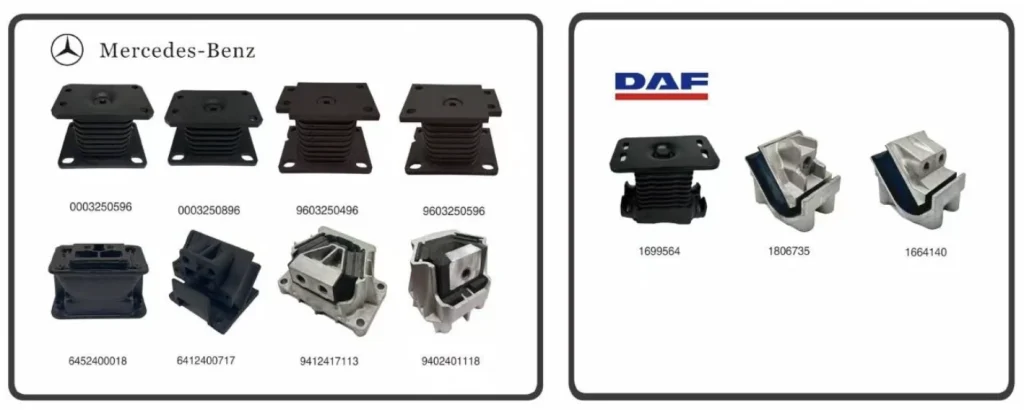
Mercedes-Benz Truck Rubber Parts
For selected Mercedes-Benz commercial-vehicle applications, available reference numbers include:
| Reference number | Position in the photograph above |
|---|---|
| 0003250596 | top row, first from left |
| 0003250896 | top row, second |
| 9603250496 | top row, third |
| 9603250596 | top row, fourth |
| 6452400018 | bottom row, first from left |
| 6412400717 | bottom row, second |
| 9412417113 | bottom row, third |
| 9402401118 | bottom row, fourth |
Mercedes-Benz mounts use a ten-digit number in the same style as the rest of the Mercedes parts system, and the last four digits identify the individual part. A clear product photo or OEM reference number helps ensure the correct replacement part is selected.
DAF Truck Rubber Parts
Selected DAF truck rubber-part references include:
| Reference number | Position in the photograph above (DAF panel) |
|---|---|
| 1699564 | first from left |
| 1806735 | second |
| 1664140 | third |
DAF references are seven digits, and the three items in the panel above illustrate why shape alone is not enough to identify a part: the first is a plain rubber mount, while the second and third are the same family of bonded mount shown from different angles. These products are supplied for aftermarket replacement needs, and final suitability should always be verified against the vehicle and the original component.
How the part numbers are written
Each of the five brands writes its rubber-part numbers in its own format, and knowing which format you are looking at tells you where the number came from and what it is likely to cross to.
| Brand | Number format | Examples |
|---|---|---|
| SINOTRUK | WG or AZ prefix plus digits | WG9725592131 · AZ9725590683 |
| Volvo | Eight or nine digits, no prefix | 720390836 · 11049001 |
| MAN | Eleven digits starting 81 | 81962105021 · 81962100550 |
| Mercedes-Benz | Ten digits, no prefix | 0003250596 · 9603250496 |
| DAF | Seven digits, no prefix | 1699564 · 1806735 |
Two practical consequences. First, a number that does not match the format of the brand you are working on is almost certainly a cross-reference from another manufacturer, and it needs to be looked up rather than guessed at. Second, Chinese catalogue and workshop systems frequently write the same SINOTRUK part with different prefix combinations, so always search the digits as well as the full string.
What to check before you fit one
Rubber mounts are bought and fitted by eye more often than any other heavy-truck part, and that is where most repeat failures come from. A few checks before the spanners come out save a second removal:
- Measure the old part, not the new one. Overall height, plate length and width, bolt-hole centres and the diameter of the bore or stud. Compare those against the new mount. A difference of a few millimetres in height changes the load the rubber carries.
- Check the bond. Look for rubber that has separated from the steel plate. The give-away is a rust-coloured line or staining where the two meet — the steel has been exposed and has begun to corrode behind the rubber.
- Check the plates. A bent or dished plate is a mount that has been overloaded or fitted with the wrong bolt length. Elongated holes are also a sign the mount has been moving.
- Check the rubber itself. Cracks running across the rubber surface, rubber that has gone hard and shiny, or rubber that has extruded out beyond the plate edge all mean the part is finished even if it still holds together.
- Check the shape. Match the mount to the photograph above before you match the number. Where a brand uses the same base mount in different heights or with different top plates, the shape is the faster check.
The signs that a mount on the truck has already failed are the ones a driver reports first: more cab movement than usual, a knock or rattle over rough ground that was not there before, vibration through the floor, and a cab that no longer sits level or has begun to touch something it should not. By the time the driver notices, the rubber has usually been failing for a while.
How to identify the correct rubber part
Before placing an order, please provide as much of the following as possible:
- OEM part number — and, if you have it, the number on the old part
- Vehicle brand, model and year
- Product photo from two or three angles, ideally with a rule or tape in frame
- Overall dimensions: height, plate size, bolt-hole centres, bore or stud diameter
- Bolt-hole distance and mounting details, including thread size
- Required quantity
The photo matters more than it sounds. A tape measure in the frame turns a picture into a measurement, and it resolves most of the ambiguity that a part number alone leaves open. This information helps reduce ordering errors and makes quotation faster.
Why Choose Sinosoon?
Sinosoon Technology Co., Ltd. supports customers looking for practical heavy truck rubber-parts solutions. We work with distributors, repair workshops and commercial-vehicle parts buyers who need consistent product identification, responsive communication and export-oriented service. Send the number or the photograph and we will confirm what we can supply and quote it.
Contact us with your inquiry:
WhatsApp: +86 15562608606
Email: market@sinosoon.com
All trademarks, vehicle brands and OEM numbers in this article are used solely for identification and application-reference purposes. Sinosoon Technology Co., Ltd. is not affiliated with the respective trademark owners.
FAQ
Can I replace a rubber mount with one that looks the same?
Not safely, unless the dimensions match. Two mounts can share the same outline and differ in overall height, hole centres or rubber stiffness. Those differences change the load the rubber carries, so a mount that bolts up can still be wrong and will fail early. Compare height, plate size, hole centres and bore diameter against the old part.
How do I know a rubber mount has failed?
The most reliable sign is a rust-coloured line or staining where the rubber meets the steel plate, which means the bond has separated and moisture has reached the steel. Cracks across the rubber, rubber that has gone hard and shiny, and rubber extruded past the plate edge all indicate the part is finished. On the truck, extra cab movement, a new knock over rough ground and floor vibration are the usual first symptoms.
Why does the same SINOTRUK part appear with both a WG and an AZ prefix?
The two prefixes belong to different parts of the SINOTRUK numbering system, and the same mounting position can be catalogued under either depending on which document you are working from. It is worth searching the digits rather than the whole string, because Chinese catalogues and workshop systems also combine the prefixes differently.
What measurements do you need to quote a rubber mount?
Overall height, plate length and width, the distance between bolt-hole centres, and the diameter of the central bore, stud or thread. A photograph of the old part with a rule or tape in frame covers most of these in one image and removes the ambiguity that a part number alone leaves open.
Are these parts original equipment or aftermarket?
Our rubber parts are supplied for aftermarket replacement. The reference numbers are used for identification and cross-reference, and final suitability should always be checked against the vehicle and the original component before fitting.
Related parts
- China Heavy Truck Sinotruk HOWO T5g T7h Tx Truck Spare Parts WG9725531603 Rubber Hose For Expansion Tank
- sinotruk A7 howo T7H truck cab front suspension parts rubber limit block AZ1664430090 and lower limit block Az1664430094
- Sinotruk parts trucks Leaf Spring Parts rubber mounting Az9725520278 HOWO Truck Rubber Support
- SINOTRUK HOWO Truck Parts Engine Rubber Support AZ9925525286
