
Electric Trucks in 2026: Market Reality, Buyer Economics and the Five Technical Routes
10/14/2026
Guía de compra de repuestos Sinotruk en Latinoamérica: HOWO y SITRAK para minería y flotas de carga
10/15/2026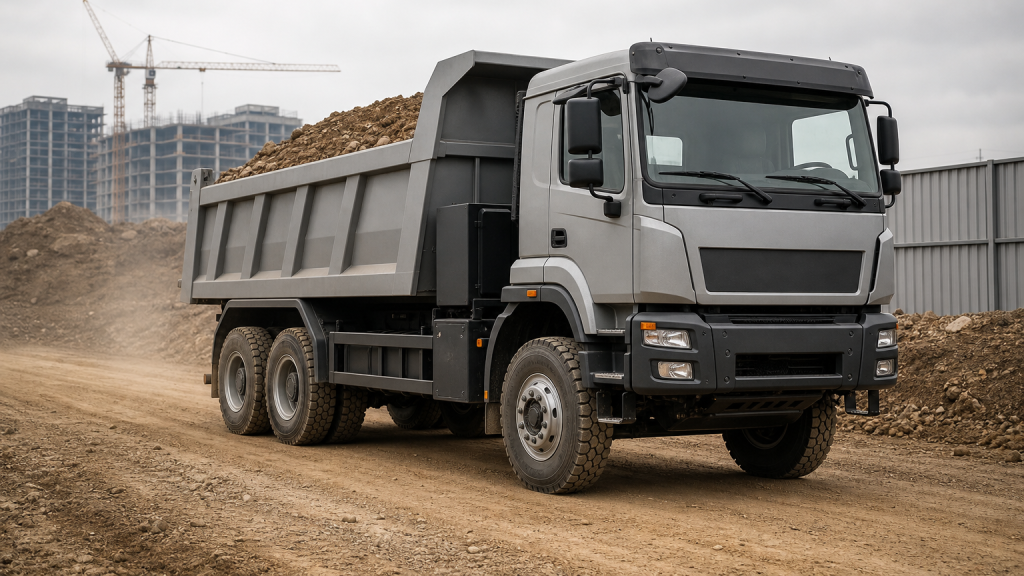
Four numbers define this truck: 380 kWh, 1,600 N·m, 50,578 N·m and 38.6%. None of them were picked from a competitor datasheet. Each one falls out of a constraint — a 25-tonne gross vehicle weight fixed by regulation, a 200 km working day, a charging window, and a site that will punish a long rear overhang. This article walks the full derivation of a 6×4 battery-electric dump truck for city construction spoil haulage and short-haul sand and gravel, and shows where the trade-offs actually land.
1. The brief: what the customer and the regulations fix
The duty cycle was defined first:
- City construction spoil haulage and short-haul sand and gravel transport
- 6×4 drive, 25,000 kg gross vehicle weight
- Up to 200 km per day, with fast charging available during the shift
- Full-load gradeability must not be a bottleneck
- Eight-year or 1.2 million km warranty on the e-powertrain (battery, motor, controller)
Two standards set the compliance frame: GB/T 18386.2-2022 for range and energy-consumption testing (the basis of type approval for this vehicle class) and GB/T 40032.2-2025 for battery-swap safety if a swap version is developed. GB 7258 covers the operational fundamentals — braking, lighting, field of view.
The genuinely difficult part is reconciling a 200 km working day with a 25 t gross weight. A battery-electric truck carries a pack and electric driveline that a diesel truck does not, so every kilogram of battery is a kilogram of payload surrendered. The whole design is therefore a search for a balance point between payload, range, power and cost — not a parts list.
2. Mass and dimensions: paying for the battery in payload
Gross weight is non-negotiable: 25,000 kg is the regulatory ceiling for this class. What the designer controls is kerb weight — and that single figure decides how much cargo the truck can legally carry.
| Model (25 t class, 2026) | Kerb weight | Payload |
|---|---|---|
| BYD T25 | 18.7 t | 6.17 t |
| Farizon M7 | 17.0 t | 7.87 t |
| Sinotruk V7-X (tunnel version) | 19.7 t | 5.17 t |
| This design (target) | 17.5 t | 7.5 t |
Farizon reaches 17 t largely through lightweight body design — but the swap version’s battery frame consumes space, so the charging version can borrow the body concept while the battery layout has to be solved independently. Across the segment, electric dump trucks carry roughly 5–8 t, which is 2–3 t less than a diesel truck of the same gross weight. That gap is the mass cost of electrification, and it recurs later in the economics.
The design target was set at 17,500 kg kerb / 7,500 kg payload — a kerb-to-GVW ratio of 0.70, which is mid-to-upper level for this class but still requires lightweighting on both the body and the chassis.
Package and dimensions: outline 9,600 × 2,550 × 3,450 mm, dump body internal 5,800 × 2,350 × 1,500 mm giving 20.4 m³, front track 2,045 mm, rear track 1,860 mm.
3. The wheelbase decision — three options, one winner
Wheelbase was the first real argument. Three candidates were costed:
| Option | Wheelbase | Body length | Verdict |
|---|---|---|---|
| A | 4,900 + 1,350 mm | 6.2 m | Best volume, but the rear overhang is too long — high risk of grounding on uneven site roads |
| B | 4,200 + 1,350 mm | 5.4 m | Good clearance, but roughly 2 m³ less volume — commercially unacceptable to the customer |
| C (chosen) | 4,600 + 1,350 mm | approx. 5.8 m | Rear overhang held near 1,200 mm: body length and site clearance both acceptable |
For context, the Sinotruk V7-X uses 4,625 + 1,350 mm (25 mm longer than this design, but its cab and body follow the same diesel-electric platform, so the difference cannot be carried across directly), while the Farizon M7 uses 4,900 + 1,350 mm — a layout that prioritises cargo capacity. This project weighted site clearance more heavily.
4. Sizing the battery: from energy consumption to 380 kWh
Energy consumption is the number worth arguing about first. Industry measurements put battery-electric dump trucks at roughly 1.78 kWh/km in mining duty and around 1.7 kWh/km on flat loaded routes. Construction spoil haulage sits between the two: there are gradients, but the empty return leg recovers energy downhill.
This design took a combined figure of 1.58 kWh/km — lower than both reference duties, with the difference justified by regenerative-braking credit. The chain then runs:
- Daily energy = 200 km × 1.58 kWh/km = 316 kWh
- Usable state-of-charge window = 0.85 (a pack is neither run flat nor kept full)
- Required capacity = 316 ÷ 0.85 ≈ 372 kWh → a 380 kWh pack is selected
A useful counter-check: a 350 kWh pack at the same consumption would deliver 350 × 0.85 ÷ 1.58 ≈ 188 km — short of the 200 km requirement. Capacity had to move up, and 380 kWh is the smallest pack that closes the loop.
5. Battery selection: LFP, 2.7 tonnes, 2C fast charge
Chemistry: lithium iron phosphate (LFP) from CATL, 380 kWh. The reason for avoiding nickel-manganese-cobalt is duty-cycle driven — construction work is harsh, and LFP offers better thermal stability with more than 3,000 cycles, giving a lower lifetime cost. BYD’s 424 kWh blade pack on the T31 follows the same LFP logic; the T31 simply carries more energy because its wheelbase and body are longer, so its requirement is different. This pack was derived from a 200 km day, not copied.
| Pack mass | 380,000 Wh ÷ 140 Wh/kg ≈ 2,714 kg (≈2.7 t) at pack level |
| System rated voltage | 618.24 V (following the Sinotruk V7-X platform reference) |
| Fast charging | 2C, dual-gun 240 kW; 20%→80% requires about 228 kWh |
| Charging time | approx. 57 minutes theoretical — 60 minutes specified |
| Low temperature | Liquid cooling plus liquid heating; no less than 80% usable capacity at −20 °C |
One detail matters commercially: some competitor datasheets quote fast charging from 40% to 80%, while this design targets 20% to 80%. The windows are not comparable, and quoting them side by side would mislead a fleet buyer.
6. Motors and driveline: how 1,600 N·m becomes 50,578 N·m
Performance targets: top speed not below 85 km/h, maximum grade not below 30%, and 0–50 km/h in no more than 15 seconds. These were benchmarked against the segment, but gradeability was recalculated from scratch — because gradeability has to be checked together with wheel-end torque. Motor torque on its own says very little.
The chosen architecture is a twin-motor layout: one permanent-magnet synchronous motor on the middle axle and one on the rear axle.
| Motor power | 140 kW rated / 220 kW peak per motor → 280 kW / 440 kW total |
| Peak torque | 800 N·m per motor → 1,600 N·m total at the input |
| Transmission | 6-speed AMT (6 forward + 1 reverse); first gear 6.5, top gear 0.78 |
| Final drive | 5.286 |
| Driveline efficiency | 0.92 |
| Wheel-end torque | 1,600 × 6.5 × 5.286 × 0.92 ≈ 50,578 N·m |
The AMT configuration is deliberate: a low first gear for torque-heavy starts on site, and a 0.78 top gear for economical highway cruising.
7. Gradeability, verified with the arithmetic
Inputs: 25,000 kg fully laden, rolling-resistance coefficient 0.015, tyre radius 0.55 m.
- Driving force at the wheel = 50,578 ÷ 0.55 ≈ 91,960 N
- Rolling resistance = 25,000 × 9.81 × 0.015 ≈ 3,679 N
- Residual driving force = 91,960 − 3,679 = 88,281 N
- sin θ = 88,281 ÷ 245,250 ≈ 0.36 → θ ≈ 21.1°; tan θ ≈ 0.386 → gradeability 38.6%
That clears the 30% target with margin. Note the caveat the designer attaches: 38.6% is a theoretical figure at ideal adhesion, and it can fall if the centre of gravity sits too far rearward or if traction is poor.
8. General layout: where the battery goes decides the axle loads
Three battery placements were compared:
| Option | Layout | Consequence |
|---|---|---|
| 1 | All packs behind the cab | Simple structure, but poor axle-load split — front axle too light, rear too heavy — and a high centre of gravity |
| 2 | All packs along the frame sides | Low centre of gravity, but reduced ground clearance and a real risk of grounding on site |
| 3 (chosen) | 140 kWh behind the cab + 120 kWh on each frame side | Balanced axle loads; centre of gravity roughly 150 mm lower than the diesel equivalent, which also improves roll stability |
Total: 140 + 120 + 120 = 380 kWh, the capacity derived in section 4 — the layout completes the mass and axle-load calculations opened in section 2.
The electric drive is arranged with both motors integrated at the middle-axle position, distributing drive to the middle and rear axles. It is a mature arrangement with low maintenance cost, which matters in the dusty, high-vibration duty of a dump truck.
9. Lightweighting: how 17.5 t is actually reached
| Frame | 700 MPa high-strength steel with topology optimisation — about 8% mass reduction |
| Front suspension | Three-leaf parabolic spring |
| Rear suspension | Four-leaf spring with rubber helper spring |
| Dump body | NM400 wear-resistant steel, 12 mm floor and 8 mm sides — the same specification used on the Farizon M7 |
| Wheel hubs | Aluminium, 15 kg saved per hub |
10. Compliance, and the honest performance boundaries
Range: 380 × 0.85 ÷ 1.58 ≈ 204 km on the combined cycle. If site gradients turn out heavier than assumed, consumption drifts toward 1.7 kWh/km and range drops below 190 km — the 200 km target has little margin, so energy consumption has to be watched closely during calibration.
Gradeability: the 38.6% figure corresponds to 91,960 N of driving force from 50,578 N·m at the wheel, as derived above.
Fast charge: 240 kW dual-gun; 20%→80% requires 228 kWh — 57 minutes theoretical, specified at 60 minutes.
Other controlled targets: 85 km/h top speed, 17.5 t kerb weight, 2.7 t pack mass.
11. The economics: 272 CNY per day, minus 2–3 tonnes of payload
The payload deficit created in section 2 has to be converted into lost revenue and carried into the total cost of ownership. On 200 km per day and 330 operating days a year:
| Electric | Diesel equivalent | |
|---|---|---|
| Daily energy | 316 kWh at 0.8 CNY/kWh = 253 CNY | 35 L/100 km at 7.5 CNY/L = 525 CNY |
| Annual energy | approx. 83,500 CNY | approx. 173,000 CNY |
| Payload | 2–3 t less | 2–3 t more |
| Purchase price | 200,000–250,000 CNY higher | baseline |
| Static payback | roughly 2.5–3 years, before deducting the payload penalty | |
Daily saving: 272 CNY, about 90,000 CNY a year. But three further costs belong in the calculation: the annual revenue lost on 2–3 t less payload, battery replacement as capacity degrades, and charger construction. The designer’s own summary of the trade-off is worth repeating: electricity saves 272 CNY a day, but the truck carries 2–3 t less — both numbers must be counted together.
12. What this means if you service or supply these trucks
From a parts and service point of view, this specification set is a preview of what will arrive in workshops:
- A 618.24 V system means high-voltage service capability, insulated tooling and technician certification become prerequisites rather than optional extras.
- A 2.7 t pack in three separate modules (cab-back plus both frame sides) means pack removal and handling is a lifting-plan and fixture question, not a spanner job.
- Two motors on the middle and rear axles shifts wear toward axle, wheel-end, suspension and tyre components, while engine-related consumables fall away on the electric truck — but remain very much alive on the diesel trucks that will keep working alongside it.
- 700 MPa frames, aluminium hubs, four-leaf rear springs with rubber helpers are all catalogue items a parts supplier should be able to match by specification, not just by vehicle model.
If you are specifying parts for an electric or diesel heavy truck fleet, browse our parts catalogue or send us your parts list with the model, VIN or part numbers. You can also see the full parameter table for this 25 t electric dump truck in English.
Closing: every number came from a constraint
The four anchor decisions: a 380 kWh LFP pack, twin motors with 1,600 N·m of combined peak torque, a 4,600 + 1,350 mm wheelbase, and a combined battery layout. The parameter loop closes cleanly — 1.58 kWh/km drives 316 kWh a day, which forces a 380 kWh pack and leaves 204 km of range; 1,600 N·m through a six-speed AMT and a 5.286 final drive produces 50,578 N·m at the wheel, which is 38.6% gradeability at full load.
The underlying logic is worth stating plainly: every figure is back-derived from the constraint set, not copied from a competitor’s specification sheet.
Source note: translated and adapted from the Chinese design study “25吨纯电动自卸车设计:380kWh电池怎么定?爬坡度38.6%怎么算?” (published 8 October 2026). Competitor parameters cited in that study are taken from public announcement data; energy-consumption reference values come from industry measurement reports. The derivations above are reproduced as published; the aftermarket commentary in section 12 is our own.

